"A cappella" literally means "in the style of the chapel." But today, it's just as likely to mean "in the style of a dubstep drop." How did we get from solemn monks chanting in stone cathedrals to Pentatonix selling out arenas? The journey is a history of human innovation and the relentless desire to make big sounds with small resources. It is a story of rebellion. First, against instruments. Then, against the church. And finally, against the limitations of the human body itself.
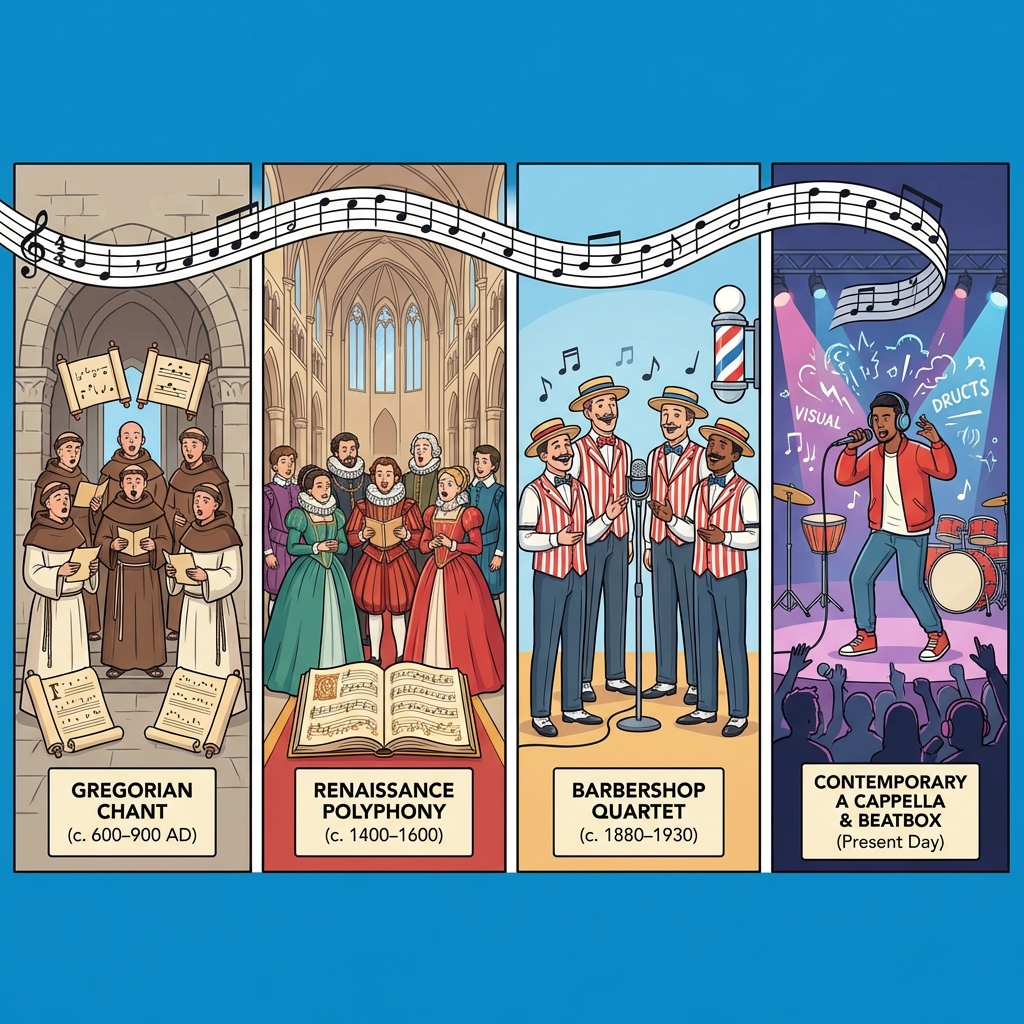
Phase 1: The Sacred Beginning (c. 600–1600)
For centuries, instruments were often banned in church, considered too secular or distracting. The voice was the only instrument worthy of praising God.
- Gregorian Chant (c. 9th Century): Monophonic (one melody), unmetered, and meditative. It was not about harmony; it was about unity of prayer.
- The Polyphonic Explosion (Renaissance): Composers like Palestrina and Josquin des Prez realized they could weave independent melody lines together. This "Polyphony" (many sounds) created complex, shifting textures that mimicked the architecture of the cathedrals they were sung in. It was the "surround sound" of the 16th century.
Phase 2: The Secular Split & Barbershop (c. 1800–1900)
As instruments took over the orchestra, a cappella moved to the pub, the parlor, and the barbershop. The African-American Roots of Barbershop: While often depicted as white men in straw boaters, Barbershop harmony has deep roots in African-American culture from the late 19th century.
- The Sound: It is defined by "The Ringing Chord"—tuning a dominant 7th chord so perfectly that the overtones reinforce each other, creating a "fifth voice" or "angel's ring" that floats above the quartet. This physics-based approach to singing laid the groundwork for modern harmony.
Phase 3: The Jazz Vocalese Revolution (1920s - 1980s)
While Barbershop was locking chords, Jazz singers were breaking them.
- The Mills Brothers: They were the first to imitate instruments on a mass scale. One brother would "play" the tuba with his lips, while another played trumpet. They proved that a voice could hold a groove.
- Take 6: In the 1980s, this group revolutionized harmony. They took 7th chords and added 9ths, 11ths, and 13ths. Their sound was so thick and complex that it sounded like a synthesizer pad. They influenced everyone from Jacob Collier to Boyz II Men.
Phase 4: The Doo-Wop Era (1950s)
Street corners replaced chapels. In cities like New York and Philadelphia, teenagers couldn't afford guitars or drum kits, so they invented them with their mouths.
- The Rhythm Section: For the first time, voices weren't just singing lyrics; they were playing instruments. The Bass sang "Bom-bom-bom" to imitate a double bass. The Tenors sang "Wah-wah" to imitate brass.
- The Progression: The famous "50s Progression" (I-vi-IV-V) became the backbone of the genre.
- The Syllables: "Sh-boom," "Doo-wop," and "Rama-lama-ding-dong" weren't just nonsense; they were rhythmic textures designed to fill the silence where a drum kit should be.
Phase 5: The Collegiate Explosion (1990s - 2000s)
Before Pitch Perfect, there was the ICCA (International Championship of Collegiate A Cappella). Colleges became the laboratories for modern a cappella.
- The Innovation: Groups like the Beelzebubs (Tufts) and On the Rocks (Oregon) started arranging complex Radiohead and Lady Gaga songs.
- The Shift: They moved away from "Swing" rhythms to "Straight" pop rhythms. They stopped snapping their fingers and started using vocal percussion. They introduced "choreography" to sell the visual impact of the song.
Phase 6: The Vocal Band Revolution (2010s–Present)
This is the era of Vocal Percussion and the Pentatonix Effect. Pentatonix changed the rules:
- The Beatboxer (Kevin Olusola): He isn't just spitting rhythms; he is replicating the kick, snare, and hi-hat of an electronic drum kit simultaneously.
- The Sub-Bass (Avi Kaplan/Matt Sallee): By using microphone proximity effect (eating the mic), they created bass frequencies that rattle subwoofers, acting as the synth-bass of the group.
- The Arrangement: They arrange songs like EDM producers, with "drops," "filters," and "loops," all created organically.
The Technology Factor
Modern a cappella is impossible without technology.
- Proximity Effect: Bass singers put their lips directly on the microphone grill. This boosts low frequencies (below 100Hz) by up to 12dB. Without mics, a human bass cannot compete with a drum kit.
- In-Ear Monitors: To sing complex jazz harmonies (like the group Take 6), singers need to hear themselves perfectly. In-Ears allows for studio-level precision on a loud stage.
- Loop Stations: Artists like Ed Sheeran and Beardyman build entire songs live, layering voice over voice. This has birthed the "Solo A Cappella" genre.
Video Experience: The Evolution of Music
Pentatonix famously summarized centuries of music history in a single medley. Watch how they seamlessly transition from chant to Beethoven to Beyonce, all with just 5 voices.
The Future?
With loop stations and effects pedals, the line between "human" and "machine" is blurring. But the core remains the same: the raw, unfiltered connection of human voices singing together. Whether it is a monk in a robe or a beatboxer in a hoodie, the instrument is the same. The urge to harmonize is written into our DNA.
Glossary of Terms
- Monophony: Music with a single melody line and no harmony (e.g., Chant).
- Polyphony: Music with multiple independent melody lines weaving together (e.g., Renaissance).
- Proximity Effect: An increase in bass or low-frequency response when a sound source is close to a microphone.
- Vocal Percussion: The art of creating drum sounds using the mouth, lips, tongue, and voice.
Want to dive deeper into classical roots? Let's explore the drama of Baroque Choral Masterpieces.
About the Author
HaND. is a choral veteran with 15 years of experience in practice and organization. A primary Bass, HaND. also demonstrates exceptional versatility as a Countertenor and Vocal Percussionist.