Breathing is the fuel of singing. It sounds obvious, yet 90% of vocal problems—pitch issues, weak tone, throat tension—can be traced back to poor breath management. For choral singers, the challenge is double. You aren't just sustaining your own sound; you are blending into a collective wall of sound. Whether you're a soprano reaching for a floaty high A or a bass grounding the harmony, your breath support dictates the quality of your performance. In this guide, we dive deep into the anatomy of support and share 5 essential breathing exercises used by professional choirs worldwide.
Part 1: The Anatomy of Support
Before we breathe, we must unlearn. Most people think "Take a deep breath" means "Heave your chest up." This is Clavicular Breathing, and it is poison for singers. It creates tension in the neck and shoulders.
Myth: "Push from the diaphragm." Reality: You cannot push the diaphragm. It is an involuntary muscle that only works on inhalation. When you inhale, it descends to pull air in. When you sing (exhale), it relaxes and floats back up.
Truth: "Support" (Appoggio) comes from postponing that relaxation. We use the Intercostal Muscles (the muscles between the ribs) and the abdominal wall to keep the rib cage expanded, managing the air pressure so it doesn't all rush out at once. Imagine you are a balloon that stays inflated even as the air leaves.
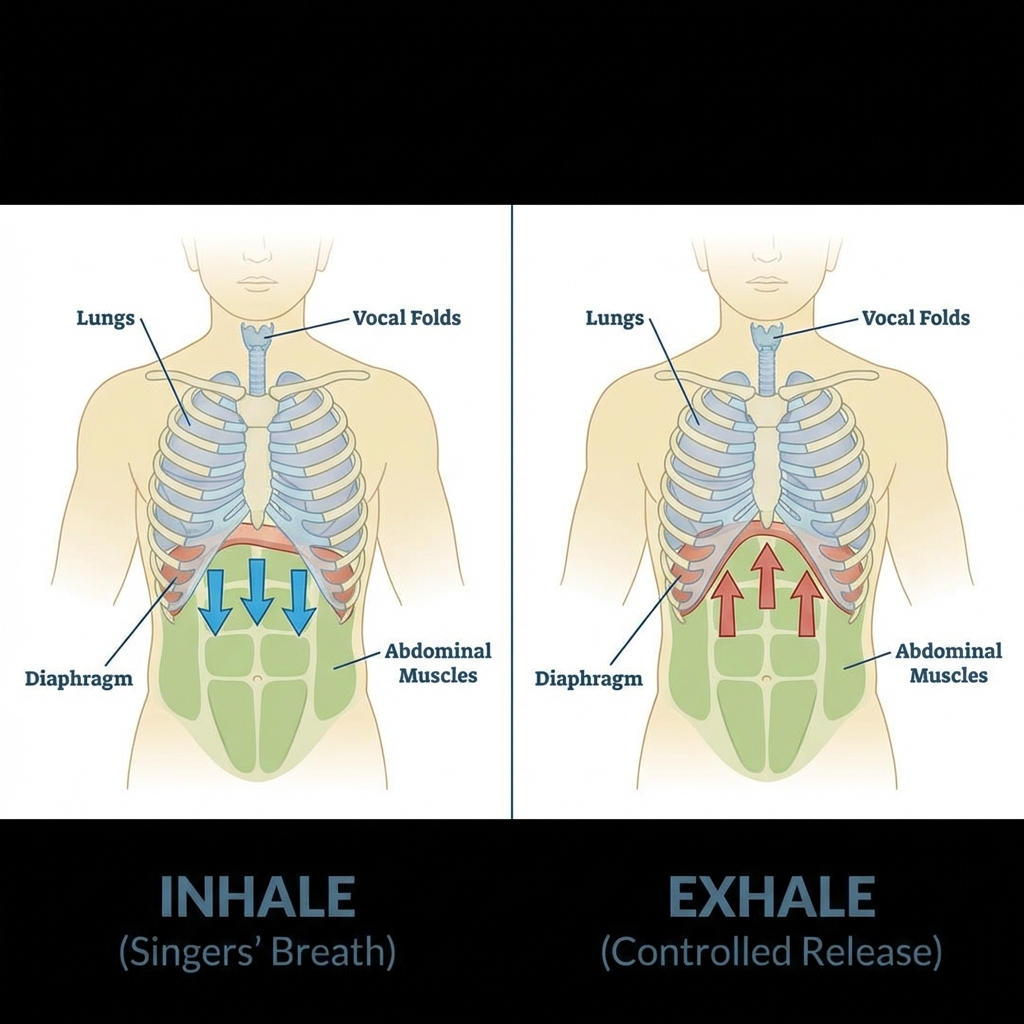
Part 2: The 5 Essential Exercises
1. The Farinelli Exercise (Breath Management)
Named after the legendary Castrato singer Farinelli, who was famous for singing phrases that lasted over a minute. This exercise builds coordination and stamina. The Method (4-4-4):
- Inhale (4 beats): Breathe in slowly through the nose. Feel your lower ribs expand 360 degrees (front, sides, and back).
- Suspend (4 beats): Hold the breath, but do not close your throat (glottis). Keep the rib cage fully expanded, as if you are still inhaling. This is the "Appoggio" (leaning) sensation.
- Exhale (4 beats): Hiss out on a steady "ssss." Keep the flow perfectly even.
- Progression: Once 4-4-4 is easy, move to 6-6-6, then 8-8-8, and eventually challenge yourself with 10-10-10 (a 30-second cycle).
2. Straw Phonation (SOVT)
This is a "Semi-Occluded Vocal Tract" exercise. Science has proven that the back-pressure created by singing through a straw helps align the vocal cords and reduces strain. Goal: Engage the support muscles without vocal strain.
- The Tool: Take a small stirring straw (coffee stirrer size is best, but a soda straw works).
- The Action: Hum a simple slide (1-5-1) through the straw.
- The Check: You should feel no air escaping around your lips. If you put your hand at the end of the straw, you should feel a steady stream of air.
- Why It Works: The resistance forces your abdominal muscles to engage automatically to push the air through the tiny hole. It "tricks" your body into perfect support.
3. The "Surprise" Breath (Inhalation Speed)
In fast tempo songs (like Handel's Messiah), you don't have 4 beats to inhale. You have a split second.
- Imagine: You just walked into a room and saw a ghost (or your crush).
- Action: Drop your jaw instantly and take a silent, rapid breath.
- Check: Did your shoulders rise? If yes, try again. The air must drop deep into the belly/lower back instantly.
- Drill: Set a metronome to 100 BPM. Breathe in for 1 beat, hiss for 3 beats. Rest for 1 beat. Repeat.
4. The Dog Pant (Diaphragmatic Activation)
This wakes up the solar plexus.
- Posture: Stand tall. Place your hand on your upper belly (epigastrium).
- Action: Stick your tongue out gently (like a dog) and pant rapidly: "Hah-Hah-Hah-Hah."
- Feel: You should feel your belly bouncing in and out. Your chest should be still.
- Warning: Do not do this for more than 30 seconds or you will hyperventilate. It is an activation exercise, not a stamina exercise.
5. Rib Cage Expansion (Intercostal Strength)
To sing long phrases, you must prevent the rib cage from collapsing too early.
- The Belt: Wrap a scarf, belt, or yoga band around your lower ribs (not your waist). Tie it tight enough that you can feel it squeezing you.
- Inhale: Breathe against the resistance. Feel the band tighten.
- Sing: Sing a phrase while trying to keep the band tight (ribs expanded) for as long as possible. Fight the urge to let the ribs collapse.
Part 3: The Art of Staggered Breathing
In a choir, we can do something a soloist cannot: sing forever. Staggered breathing creates the illusion of an unbroken line of sound. The Golden Rules:
- Never breathe on a bar line. That's where the audience expects a breath. Breathe in the middle of a sustained note.
- Fade Out, Fade In. Don't just stop. Decrescendo quickly, take a breath, and crescendo back in.
- Leave out a word. If the text is "Gloria in excelsis Deo," sing "Gloria in (breath) -celsis Deo." The audience will hear the word "ex" from your neighbor.
- Vowel Match. When you re-enter, your vowel must perfectly match the color of the section, or it will pop out.
Video Tutorial: The 3 Types of Breathing
For a visual demonstration, watch James Davey explain the physiological mechanics. Pay attention to his "Floor Breathing" technique.
Final Thoughts
Consistency is key. You don't get abs by doing 100 sit-ups once a month; you get them by doing 10 every day. Breath support is the same. Spend 5 minutes at the start of every rehearsal on these exercises. As a choral singer, your body is your instrument—tune it with breath, and the music will follow.
Ready to tackle more advanced techniques? Check out our next article on Sight-Singing for Beginners.
About the Author
HaND. is a choral veteran with 15 years of experience in practice and organization. A primary Bass, HaND. also demonstrates exceptional versatility as a Countertenor and Vocal Percussionist.