There is a moment in every choir concert that brings the house down: the pop medley. Whether it is Taylor Swift or The Beatles, contemporary music connects with audiences instantly. It bridges the gap between the classical tradition and the songs people hum in their cars.
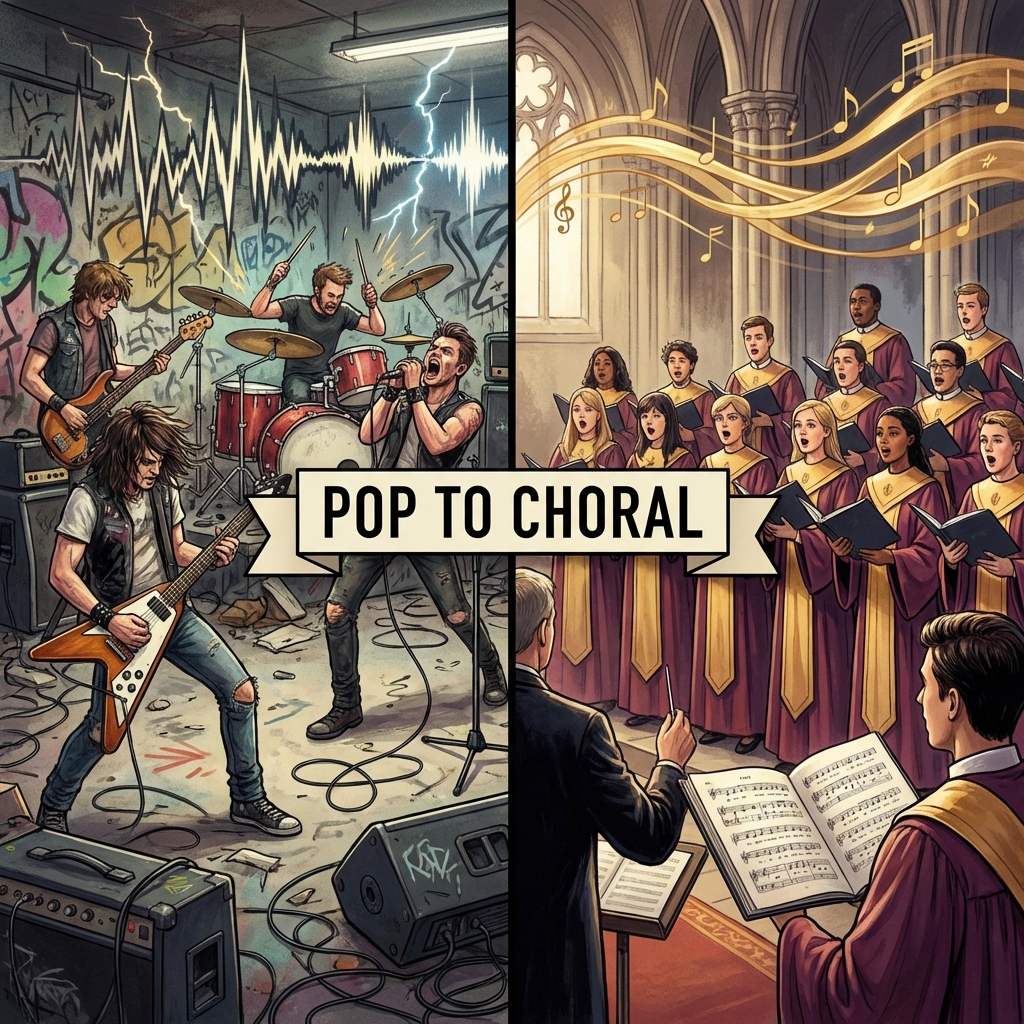
But you can't just hand a choir the piano/vocal sheet music and hope for the best. Piano accompaniments are often designed to support a solo voice, not to be sung by 40 people. To make a pop song sound "choral" and effective, you have to translate it. You are taking a song built on drums, bass guitars, and synthesizers, and re-imagining not just the notes, but the energy using only the human voice.
In this guide, we will walk through the translation process, the crucial (and often ignored) legal requirements, and the secrets to making your choir groove.
1. The Boring But Essential Part: Copyright
Before you write a single note, you must address the legal elephant in the room.
"I'm just arranging it for my church/school choir, so it's fine, right?" Technically, no.
Arranging a copyrighted song is considered creating a "derivative work." Under copyright law, you need permission from the copyright holder (usually the music publisher) to create this arrangement.
- Performance Rights: If you perform the song in public, the venue usually has a blanket license (ASCAP/BMI/SESAC) that covers the performance.
- Arrangement Rights: This is separate. You cannot legally write out and distribute copies of your arrangement without permission.
- The Solution: Websites like ArrangeMe (by Hal Leonard) or Sheet Music Plus allow you to self-publish your arrangement of approved songs legalizing the process. Alternatively, you can contact the publisher directly for a print license, though this can be slow.
2. The Translation Process: Deconstructing the Track
Pop music relies heavily on production tricks. Choirs rely on harmony and texture. Your job is to identify the core elements of the track.
Listen to the original on repeat and identify:
- The Hook: What is the earworm? Is it the vocal melody, or a specific synth riff? (Think of the synth intro to "Sweet Dreams" by Eurythmics). You must include this.
- The Groove: What are the drums doing? Is it a straight rock beat, a swing, or a complex syncopation?
- The Build: Pop songs grow. Verse 1 is usually thin; the final Chorus is a wall of sound. Your arrangement must mimic this dynamic arc.
3. Creating the Groove (Without Drums)
The most common mistake in amateur arrangements is a "plodding" rhythm where everyone sings on the beat.
The Bass Line
In pop, the bass guitar often plays a surprisingly simple but rhythmic pattern. In a choir, the Basses need rhythmic "bounce."
- Avoid: Long, sustained whole notes (unless it’s a ballad).
- Use: Syllables that mimic the instrument. "Dm" (pronounced 'doom'), "Ba", or "Dum".
- Tip: If the bass guitar plays distinct 8th notes, give your Bass singers 8th notes with rests in between to keep it tight.
The Engine Room (Tenors/Altos)
Often, the Tenors or Altos act as the "rhythm guitar" or the "hi-hat."
- Ostinatos: Create repeating rhythmic patterns (ostinatos) that lock in with the bass. Patterns like "Tak-a-tak-a" or "Zzz-zuh" can add forward momentum.
- Syncopation: Pop music lives on the off-beat. Give your inner voices some syncopation to create energy against the straight beat of the melody.
4. Thicken the Harmony
Pop songs often use simple triads (Major/Minor chords). To make it sound lush and "choral," you need to add color.
- Add the 9th or 2nd: In a C Major chord (C-E-G), adding a D creates a rich, modern sound often associated with composers like Eric Whitacre, but used extensively in pop a cappella (think Pentatonix).
- Suspensions: Delay the arrival of the chord tone. If the melody lands on a C, hold a D in the accompaniment for a moment before resolving it down. This creates emotional tension.
5. Vocal Percussion 101
You don't need a world-class beatboxer, but having a "Vocal Percussionist" (VP) can stabilize the choir.
The "Boots and Cats" Method:
- Kick Drum (B): Make a "B" sound but build pressure behind your lips before releasing. Keep it low and tight.
- Snare Drum (K/Psh): A sharp "K" sound (using the back of your throat) or a "Psh" sound.
- Hi-Hat (t/ts): A light "t" or "ts" sound.
Basic Beat: "B... t... K... t..." (Kick, hat, Snare, hat). Even a simple beat gives the choir a metronome to lock onto.
6. Texture Management
Don't have everyone sing all the time. A common fatigue in choral pop is "wall of sound" syndrome.
- Verse 1: Soloist + extremely light backing (maybe just humming or Basses).
- Pre-Chorus: Add Altos/Tenors building the chord.
- Chorus 1: Full 4-part homophony (block chords).
- Bridge: Break it down! Go to polyphony, or drop out entirely to let a Vocal Percussion solo shine.
- Final Chorus: Key Change (optional, but classic) + Descant (Sopran 1 soaring above the melody).
7. The "Ooh" vs. "Ah" Dilemma
Backing vocals need specific syllables to emulate instruments. The choice of vowel changes the mood entirely.
- Strings/Pads: Use "Ooh" (dark, warm) or "Mmm" (intimate).
- Brass/Horns: Use "Bah" (punchy), "Dah", or "Pa".
- Electric Guitar: Use "Wah" or "Na" (nasal, cutting).
- Synth: Use "Zzz" or "Zh" (voiced consonants) to create a buzzy, electric texture.
Video Tutorial: Creating Rich Harmonies
Knut Rygnestad demonstrates his techniques for creating rich and resonant choral chords. Understanding how to voice your chords is essential for transforming a simple pop tune into a lush choral arrangement.
Recommended viewing: A cappella arranging: How to create rich and resonant choral chords | Choir With Knut
Final Advice: Pop Styling
Finally, allow your choir to sing like pop singers.
- Vowels: Classical technique demands tall, round vowels ("Ah" as in "Father"). Pop use brighter, wider vowels ("A" as in "Cat") closer to speech.
- Vibrato: Keep it straight! Pop harmonies lock better with minimal vibrato. Save the vibrato for the end of a long note.
Arranging is a skill developed by doing. Start with a simple song, respect the copyright, and have fun finding the groove.
Arranging requires knowing your instrument. Make sure you understand Voice Ranges and Textures before you write that High C.
About the Author
HaND. is a choral veteran with 15 years of experience in practice and organization. A primary Bass, HaND. also demonstrates exceptional versatility as a Countertenor and Vocal Percussionist.